
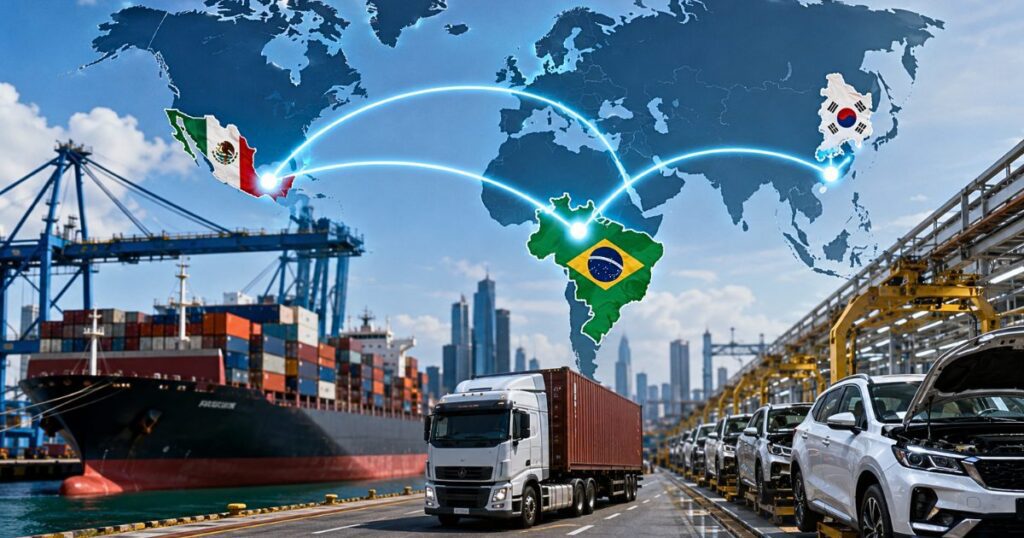
Korean investment and closer ties with Brazil strengthen nearshoring, drive new supply chains, and consolidate Mexico as an industrial hub.
Brazil and Mexico: The Two Pillars of Korea’s Latin America Strategy
While Kia’s investment in Mexico has garnered attention due to its immediate impact on the automotive industry, South Korea’s strategy in the region is far broader. Alongside strengthening its manufacturing presence in Mexico, Seoul has intensified its engagement with Brazil to build a long-term alliance based on trade, technology, and supply chain security.
During a visit to Brasília, both governments agreed to restart negotiations for a Free Trade Agreement between South Korea and Mercosur—an initiative that had been effectively stalled for five years.
President Luiz Inácio Lula da Silva’s administration believes this agreement will help diversify Brazil’s export markets and reduce reliance on traditional economic partners. Meanwhile, South Korea seeks to secure a supply of critical minerals essential for manufacturing batteries, semiconductors, electric vehicles, and next-generation technologies.
Far from being isolated initiatives, the investments in Mexico and the trade opening with Brazil are part of a unified economic architecture designed by South Korea to establish a regional platform.
The Continent’s New Industrial Corridor
Seoul’s vision is taking shape through an integration strategy that leverages the unique strengths of each country.
Brazil contributes strategic resources—such as iron ore, lithium, nickel, and other minerals vital to the global energy transition—while also serving as South America’s largest economy.
Mexico, for its part, offers one of the continent’s most competitive manufacturing platforms, preferential access to the U.S. market via the USMCA, and established industrial infrastructure for producing vehicles, auto parts, electronic components, and technology products.
This combination creates an economic corridor in which South America supplies raw materials of high strategic value, and Mexico transforms them into high-tech products destined for the North American market.
For South Korea, this integration represents a way to strengthen global supply chains, mitigate geopolitical risks, and reduce dependence on other Asian markets. Nearshoring and Mercosur: A Complementary Strategy
Nearshoring and Mercosur: A Complementary Strategy
Far from competing with one another, Mexico’s nearshoring and the strengthening of trade ties with Brazil follow the same logic.
While Mexico solidifies its position as an advanced manufacturing hub for exports to the United States and Canada, Brazil bolsters the supply of raw materials, energy, and food needed to keep an increasingly integrated regional industry running.
The result is an economic model in which South Korea diversifies risk, Latin America attracts greater investment, and supply chains become more resilient in the face of rising international protectionism.
A New Economic Axis for the Coming Decade
South Korea’s strategy confirms that the future of international trade will not depend solely on major treaties between powers, but rather on regional networks capable of integrating production, innovation, logistics, and natural resources.
With Brazil leading the strengthening of Mercosur and Mexico establishing itself as the primary destination for nearshoring in North America, South Korea is building an economic bridge between Asia and Latin America—one that could become one of the most dynamic industrial corridors of the coming decade.
This new trade axis is not merely a response to current geopolitical tensions; it also anticipates a more multipolar global economy, where cooperation among emerging nations plays an increasingly vital role in investment, manufacturing, and technological development.
Por Orlando J. Gutiérrez