
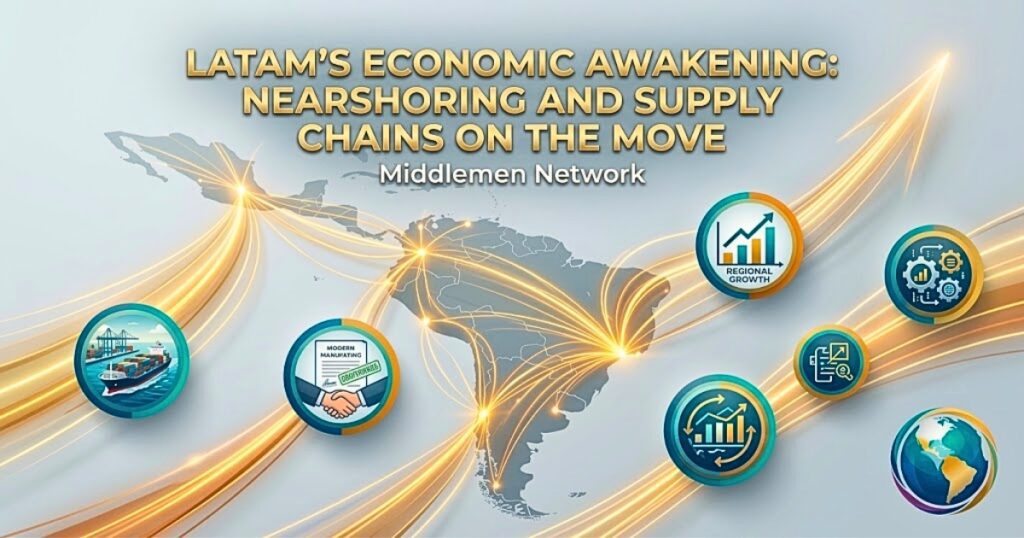
The reconfiguration of global supply chains opens up historic opportunities for companies, investors, and regional suppliers in 2026.
Latin America Positions Itself as a New Strategic Hub for International Trade
The transformation of the global economy is redefining the business landscape, and Latin America is emerging as one of the main beneficiaries of this change. The nearshoring strategy, which involves relocating industrial and service operations to countries closer to consumer markets, has been consolidated by 2026 as one of the most important drivers of regional economic growth.
This phenomenon responds to the need for multinational companies to build more resilient supply chains, reduce delivery times, minimize logistical risks, and strengthen their competitiveness in a global environment marked by geopolitical and trade uncertainty.
For Latin America, this trend represents an unprecedented opportunity to attract foreign investment, strengthen its industrial capacity, and generate new long-term trade alliances.
Global Companies Accelerate Their Arrival in the Region
Several international corporations have begun to relocate parts of their production processes and distribution centers to Latin American countries, driven by competitive advantages such as geographic location, trade agreements, talent availability, and more efficient operating costs.
This process is energizing sectors such as:
- Advanced manufacturing.
- Automotive industry.
- Technology.
- Electronics.
- Logistics.
- International trade.
- Business services.
- Infrastructure.
The result is sustained growth in demand for reliable suppliers, specialized companies, logistics operators, consultants, and brokers capable of facilitating business connections between international buyers and local markets.
Nearshoring also transforms small and medium-sized enterprises (SMEs).
Although much of the attention is usually focused on large investments, the true impact of nearshoring also reaches thousands of SMEs that now have the opportunity to integrate into global supply chains.
Those organizations that manage to raise their quality standards, digitize their processes, and strengthen their operational capabilities will be better positioned to become strategic partners of international companies.
The new business dynamic no longer depends solely on the size of a company, but on its ability to respond quickly and build trust.
Three Factors That Will Make the Difference
Experts agree that success in this new economic environment will depend primarily on three fundamental elements.
Immediate Response
International markets demand agile suppliers capable of fulfilling requests in increasingly shorter timeframes. Speed of reaction has become a determining factor in securing new business opportunities.
Efficient Logistics Infrastructure
Having transportation, storage, and distribution networks that effectively connect local production with international markets will be one of the main competitive differentiators.
Logistics efficiency allows for reduced costs, improved delivery times, and strengthened trust between customers and suppliers.
Business Relationships Based on Trust
Beyond price, foreign companies seek to establish long-term relationships with reliable, transparent partners capable of consistently meeting international standards.
Corporate reputation, compliance, and adaptability will be increasingly valuable assets within the nearshoring ecosystem.
Middlemen Network focuses on connecting business opportunities
In this context of economic transformation, companies specializing in business intelligence and business development are acquiring a strategic role in facilitating connections between investors, suppliers, and new markets.
Middlemen Network focuses its work on identifying business opportunities, analyzing market trends, and connecting companies with high-potential projects, reducing the uncertainty that typically accompanies international operations.
Its model seeks to simplify negotiation processes by identifying strategic partners, market information, and pre-evaluated opportunities to facilitate business decision-making.
An opportunity that is just beginning
Economic projections indicate that the relocation of investments will continue to expand in the coming years, strengthening Latin America’s role in global trade.
The evolution of international supply chains opens a favorable scenario for companies that decide to prepare, innovate, and build solid business relationships.
More than a temporary trend, nearshoring represents a structural transformation that is changing how production, distribution, and business are conducted in the region. For organizations that manage to adapt to this new reality, economic growth can become a sustained, long-term opportunity.
Por Orlando J. Gutiérrez