
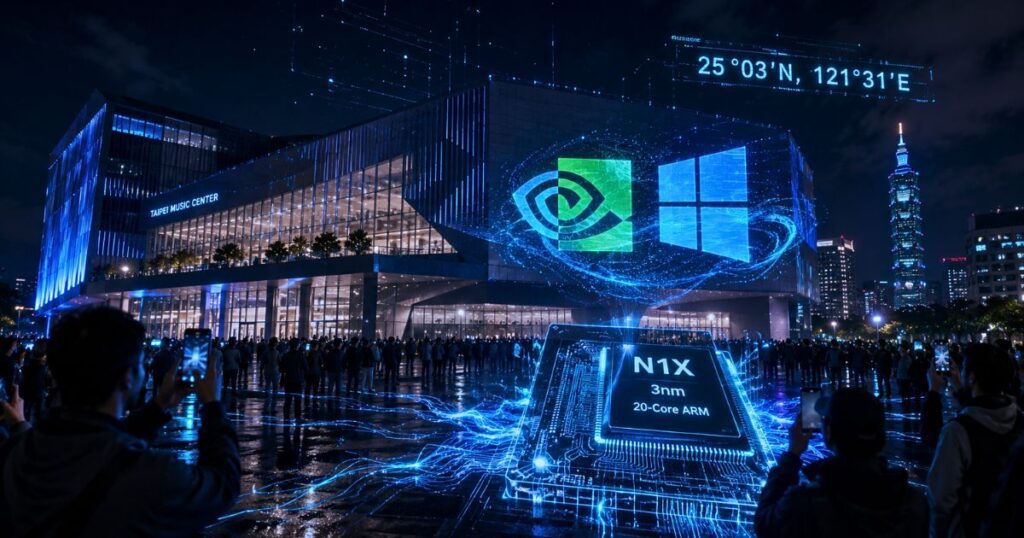
Secret coordinates, a 3-nanometer chip and a silent alliance: everything points to a before and after at Computex 2026.
A Digital Enigma Unveiled on the Doorstep of Computex 2026
Taipei, Taiwan. The countdown to the year’s most influential technology fair began with a move few expected, but which everyone deciphered in a matter of minutes. In the early hours of Thursday, the official Nvidia and Windows accounts on the social network X set off alarm bells by posting, just seconds apart, the same message laden with symbolism: “A new era of the PC.”
At first glance, the phrase could be read as a routine marketing statement. But beneath it, hidden in plain sight, a numerical code turned speculation into certainty. Entering those digits into Google Maps led to an inescapable destination: the Taipei Music Center, the very venue where Nvidia has already set up its stage for the keynote address on Monday, June 1st. There was no room for coincidence.
Silence broken, rumors contained
The social media buzz reached such a magnitude that Windows’ top brass decided to intervene. Pavan Davuluri, executive vice president of the division, used his personal X profile to immediately put a stop to one of the most widespread theories: “This is not Windows 12,” he wrote succinctly but categorically.
The clarification, far from cooling interest, redirected attention to the area that most excites analysts: hardware. And specifically, to a component that has been in development for years in Nvidia’s secret laboratories.
The silicon that could change everything
Everything points to the conference’s big reveal being the long-awaited Accelerated Processing Unit (APU) with ARM architecture, a project that until now had only circulated in leaks and patents. Sources close to the industry assure that the chip will be presented under the code names N1 or N1X, depending on the variant.
What makes this component different is not only its hybrid nature—integrating high-performance CPUs and GPUs—but also its collaborative origins. According to documents obtained by this newsroom, the N1X was developed in a strategic alliance with MediaTek, the Taiwanese semiconductor giant for mobile devices, and will be manufactured by TSMC using its 3-nanometer process. This combination promises unprecedented energy efficiency and transistor density in the personal computer ecosystem.
With this move, Nvidia is preparing to directly challenge Qualcomm’s Snapdragon X2 Elite, the other major contender to dominate the next generation of PCs with ARM architecture.
Leaks that are already causing concern in rival labs
Although Jensen Huang’s company has not officially confirmed any specifications, the clues left on performance testing platforms speak for themselves. A leaked Geekbench benchmark from 2025 already showed a 20-core chip operating at base frequencies of at least 2.81 GHz. But the most explosive news came later: recent leaks suggest that the N1X’s integrated graphics unit (iGPU) could offer performance equivalent to a GeForce RTX 5070 Ti, currently a high-end dedicated graphics card.
If these figures are confirmed, the line between integrated and dedicated graphics would completely blur. And with that, the standard of what we understand as a traditional PC would take a qualitative leap, especially in native artificial intelligence tasks and intensive graphics processing.
A new era, this time for real. The headline that Nvidia and Windows chose to launch their anticipation campaign might sound like déjà vu. The industry has been promising the “year of the ARM PC” for years. But this time the playing field is different: the manufacturer of the world’s most advanced GPU, TSMC’s closest partner, the backing of the most widely installed operating system on the planet, and a local partner like MediaTek form an unbeatable quartet.
Everything will be ready on Monday, June 1, when the curtain rises at the Taipei Music Center. Those expecting a incremental announcement are mistaken. What’s coming, if the signs are correct, isn’t an evolution. It’s a complete overhaul.