
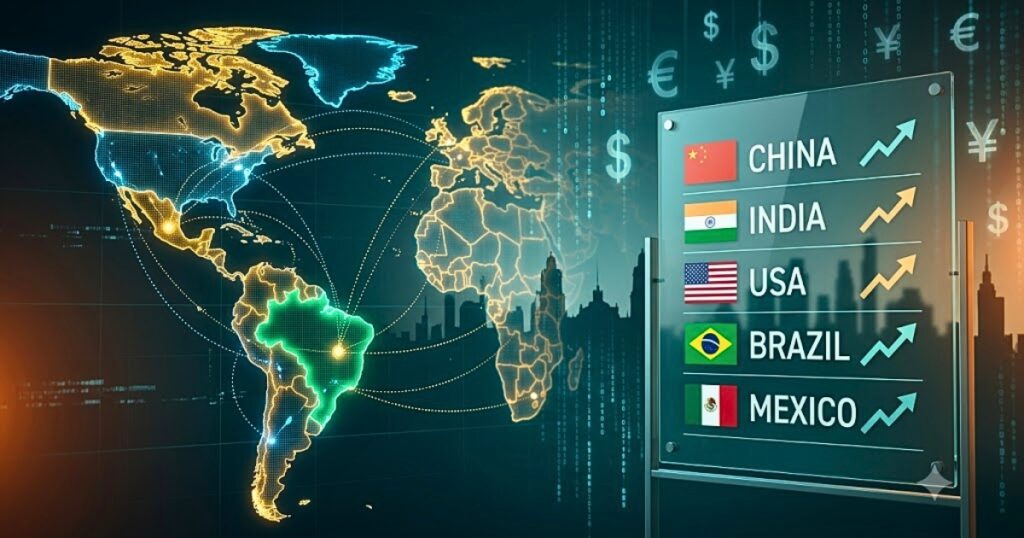
Goldman Sachs projects a profound global economic shift by 2075, with Asia leading growth and Brazil and Mexico emerging as Latin American powerhouses.
Brazil and Mexico Aim for Economic Leadership by 2075
Goldman Sachs Anticipates a Historic Transformation of Global Economic Power
The map of the global economy could undergo one of the greatest transformations in history over the next five decades. The projections developed by Goldman Sachs in its report *The Path to 2075* present a scenario where Asia will consolidate its economic dominance, while Latin America will see Brazil and Mexico emerge as the two major regional powers capable of competing with the world’s largest economies.
The study, based on an analysis of 104 economies, does not aim to make a definitive prediction, but rather to identify the structural trends that could shape global economic growth until the middle of the 21st century. Variables such as demographic trends, productivity, technological innovation, capital accumulation, and institutional stability are the main elements considered in constructing this long-term scenario.
Asia will concentrate the greatest weight of the world economy
According to the investment bank’s estimates, economic leadership will no longer be held by the United States, giving way to a much more dominant Asian axis.
China would occupy the top position with a Gross Domestic Product (GDP) of approximately $57 trillion, followed by India with roughly $52.5 trillion, while the United States would fall to third place with around $51.5 trillion.
This configuration represents a fundamental shift from the prevailing economic order since the late 20th century, when the US economy maintained clear global supremacy.
One of the most striking cases is that of India, whose growth would be supported by a young population, a constantly expanding labor market, and rapid technological development. Goldman Sachs believes these factors will allow the country to significantly outperform established economies like Japan and Germany.
Brazil will lead Latin America in the Top 10
While Asia is projected to experience the greatest growth, Latin America would also have prominent representatives among the world’s leading economies.
Brazil emerges as the best-positioned Latin American nation, projected to be the **eighth largest economy in the world**, with a GDP of approximately **$8.7 trillion**.
The size of its domestic market, its abundance of natural resources, the strength of its agribusiness sector, and a diversified economy are some of the elements that support this scenario of sustained growth.
Its demographic weight also plays a fundamental role, as it allows for increased domestic consumption and strengthens national production in the coming decades.
Mexico consolidates its role among the major economies
Mexico is also among the key players in the report.
Estimates place the country in **eleventh position in the world ranking**, with an approximate Gross Domestic Product of **$7.6 trillion**, a figure that would put it above economies traditionally considered among the strongest on the planet, such as Japan, France, and Russia.
Although Goldman Sachs does not attribute this performance to specific factors such as the United States-Mexico-Canada Agreement (USMCA), several specialists believe that trade integration with North America, the relocation of production chains, and the phenomenon of nearshoring could further strengthen Mexico’s position in the coming decades.
Growth will depend on human capital and innovation
The report indicates that the competitive advantage of Brazil and Mexico is not solely explained by the size of their economies.
Both countries possess structural characteristics that could drive sustained development, including:
- Large-scale domestic markets.
- Ample labor availability.
- Diversified economies.
- Greater capacity to attract foreign investment.
- Relatively deep financial systems.
- Business and technology ecosystems with expansion potential.
The combination of these factors would allow for increased productivity and facilitate the incorporation of new technologies in strategic sectors.
“Population will be the main driver of growth
One of the central findings of the study”
By Orlando J. Gutierrez