
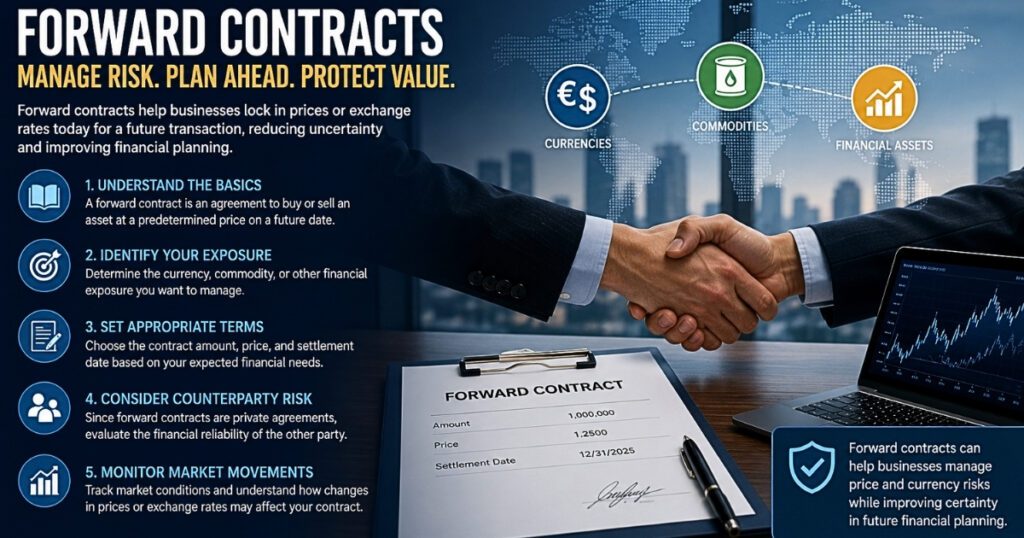
Understanding exposure, setting proper terms and assessing counterparties can help companies manage uncertainty in currencies and commodity prices.
Financial markets are constantly influenced by economic conditions, interest-rate expectations, currency fluctuations, commodity prices and geopolitical developments. For businesses exposed to these variables, unexpected market movements can significantly affect operating costs, revenues and future cash flows.
In this environment, companies increasingly rely on financial risk-management strategies designed to provide greater visibility over future obligations and reduce the potential impact of adverse price movements.
One of the instruments available for this purpose is the forward contract, a financial agreement that allows two parties to establish today the conditions for buying or selling an underlying asset at a predetermined price on a future date.
When properly structured, forward contracts can provide businesses with greater certainty when planning future financial commitments, particularly when their operations involve foreign currencies or commodities.
What Is a Forward Contract?
A forward contract is a private agreement between two parties to purchase or sell an asset at an agreed price on a specified future date.
The underlying asset can include a currency, commodity or another financial instrument. Unlike a spot transaction, where the exchange takes place immediately or within a short settlement period, a forward contract establishes the terms of a transaction that will occur later.
This structure can be particularly useful for companies that already know they will have a future financial obligation.
For example, an importer that expects to make a payment in U.S. dollars several months from now may use a currency forward to establish an exchange rate in advance. This can help the company reduce uncertainty regarding the local-currency cost of that future payment.
The objective is not necessarily to predict where the market will move, but rather to manage the financial consequences of movements that could negatively affect the business.
Start by Identifying the Financial Exposure
Before entering into a forward contract, a company needs to understand precisely what risk it wants to manage.
Financial exposure can arise from several sources. Businesses involved in international trade may be exposed to foreign-exchange movements, while manufacturers and other industries may face significant fluctuations in the cost of commodities and raw materials.
A proper risk assessment should consider questions such as:
- What asset or currency creates the exposure?
- What is the amount that needs to be managed?
- When will the financial obligation or cash flow occur?
- How sensitive is the business to market fluctuations?
- Is the exposure a one-time event or part of recurring operations?
Understanding these factors is essential because a hedge that does not correspond to the company’s actual exposure may fail to provide the expected protection.
Setting the Right Contract Terms
Once the exposure has been identified, the company must determine the appropriate terms of the forward agreement.
The contract amount, agreed price and settlement date are among the most important elements.
These terms should reflect the company’s expected financial requirements. A contract that is too small may leave part of the exposure unmanaged, while an unnecessarily large position could create a financial commitment that exceeds the company’s actual needs.
The timing of expected payments and receipts should therefore be carefully evaluated before entering into the agreement.
Effective risk management requires alignment between the financial instrument and the underlying business activity.
Counterparty Risk Cannot Be Ignored
Another important consideration is the financial strength of the counterparty.
Forward contracts are generally negotiated privately between two parties. As a result, the ability and willingness of the other party to fulfill its contractual obligations becomes an important component of the overall risk assessment.
Even if market conditions develop as anticipated, a contract may create difficulties if the counterparty cannot meet its obligations at settlement.
Companies should therefore evaluate the financial reliability, creditworthiness and track record of the institution or business with which they are entering into the agreement.
Risk management is not limited to market risk. Counterparty or credit risk must also be considered.
Market Monitoring Remains Essential
Entering into a forward contract does not mean that a company should stop monitoring financial markets.
Currency exchange rates, commodity prices, interest rates and broader economic conditions can change significantly between the date a contract is established and its settlement date.
Regular monitoring can help financial managers understand how the company’s position is evolving and whether its broader risk-management strategy remains aligned with its objectives.
It is also important to understand that a forward contract establishes agreed terms that generally remain in place regardless of subsequent market movements.
If the market moves significantly after the agreement is signed, the economic value of the contract may change relative to current market prices.
This is one reason why businesses should fully understand the structure and potential consequences of a forward before using it.
Greater Certainty for Financial Planning
One of the main potential benefits of forward contracts is increased predictability.
For companies conducting international business, currency volatility can make future costs and revenues difficult to forecast. A significant exchange-rate movement can alter the local-currency value of an import, export or other international transaction.
Similarly, businesses dependent on commodities may face challenges when input prices change rapidly.
A carefully designed hedging strategy can help reduce the uncertainty associated with these movements and improve the company’s ability to prepare budgets and forecast cash flows.
Greater predictability can support more informed financial planning and reduce the potential impact of unexpected market movements.
A Risk-Management Tool, Not a Guarantee
Forward contracts should not be viewed as a universal solution or as a mechanism that guarantees profits.
Their usefulness depends on the company’s individual circumstances, financial exposure, objectives, risk tolerance and understanding of the contractual obligations involved.
The decision to use derivatives should therefore form part of a broader financial risk-management framework.
Companies should establish clear objectives before entering into a transaction and ensure that the size and duration of the hedge correspond to the underlying exposure.
Five Key Considerations Before Using a Forward
1. Understand the instrument
Know how the contract works, what obligations it creates and how its value may change.
2. Measure the exposure
Identify the specific financial risk and determine its size and timing.
3. Establish appropriate terms
Set the amount, price and settlement date according to actual business requirements.
4. Assess the counterparty
Evaluate the financial strength and reliability of the other party.
5. Monitor market conditions
Follow exchange rates, commodity prices and other relevant market variables throughout the life of the contract.
Turning Uncertainty Into Better Financial Planning
For businesses operating in volatile markets, effective risk management can be an important component of long-term financial stability.
Forward contracts can provide a mechanism for managing certain currency and price exposures while improving visibility over future financial obligations.
Their greatest value, however, comes from disciplined implementation.
Rather than attempting to predict every movement in the market, companies can use appropriate risk-management tools to prepare for potential adverse scenarios.
The key is to understand the exposure, select the appropriate instrument, establish suitable contractual conditions and continuously evaluate the associated risks.
In an increasingly unpredictable financial environment, the ability to manage uncertainty can become a competitive advantage.