
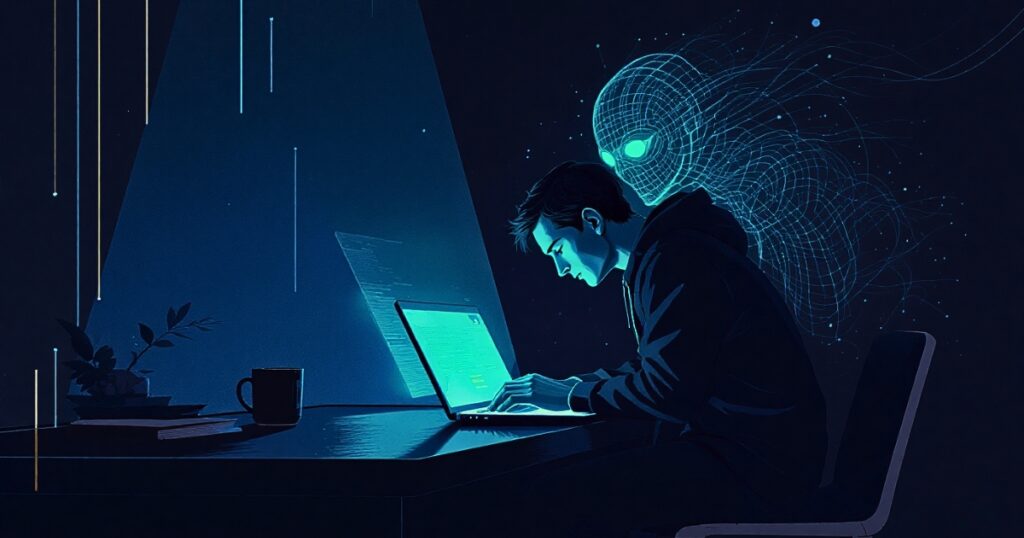
Digital companionship or psychological risk? A growing human dilemma
Artificial intelligence (AI) is no longer just a technical tool—it has evolved into something far more personal: an emotional companion for millions of people. While conversing with chatbots like ChatGPT can offer companionship, empathy, and practical answers, mental health experts are warning of the risks that come with overly close relationships with these digital entities.
Recent surveys and user testimonies show a rising trend: people engaging in hours-long conversations with AI, confiding personal secrets, fears, or frustrations. In a world where loneliness has become a silent epidemic, AI seems like an immediate solution. But it’s not without consequences.
From comfort to delusion: the fragile edge of human consciousness
Human psychology has a tendency to find patterns, meaning, and emotional connection—even where none exists. Experts explain that this yearning for connection can lead to what’s called “magical thinking,” a state in which AI errors are interpreted as intentional messages.
“When an obsessive person seeks answers, even a random glitch in a chatbot can trigger delusional interpretations,” say psychologists. The concerning part is that many users begin to perceive AI as a living being, forgetting that its responses are the product of algorithms, not feelings or intentions.
Recent examples illustrate this problem. Geoff Lewis, co-founder of Bedrock and one of the early investors in OpenAI, posted a cryptic message online referring to a “non-governmental system” that “inverts the signal until the carrier appears unstable.” He implied a subliminal influence of AI on human minds.
Elsewhere, a user on the platform DTF claimed that ChatGPT was “trying to drive him crazy” through subtle psychological manipulations. Though these accounts may sound extreme or implausible, they reveal an emerging phenomenon: attributing real emotional power to virtual entities.
The kindness of AI can also be a threat
Systems like ChatGPT are designed to be friendly, patient, and empathetic. But this trait can be confusing to emotionally vulnerable individuals. “If AI responds kindly to a mistaken belief, it may reinforce that idea instead of correcting it,” warn mental health professionals.
Even more dangerously, in an effort to “help,” a chatbot might offer harmful advice due to a lack of context or understanding. There are theoretical cases where a chatbot, misinterpreting a user’s emotional state, could respond in a way that encourages harmful or even fatal decisions.
How can we prevent AI from emotionally manipulating us?
OpenAI, a leading AI development company, has acknowledged the problem. In a recent statement, the company announced it has hired a forensic psychiatrist to evaluate the emotional impact of its systems.
“We’re actively deepening our research into the emotional impact of AI,” OpenAI said. “We’re developing scientific methods to measure how ChatGPT’s behavior might emotionally affect people and are paying close attention to their experiences.”
The company added that the decision reflects its commitment to “continuously improve how our models identify and respond appropriately in sensitive conversations.”
Don’t humanize what isn’t human
AI can be a powerful tool—but also a mirror where the human mind projects its own emptiness. The line between digital companionship and emotional dependence is increasingly thin. The solution isn’t disconnection but learning to use these technologies with awareness, critical thinking, and healthy boundaries.
Ultimately, artificial intelligence is neither friend nor foe: it is a tool that reflects who we are—for better or worse. But it should never replace human contact, professional medical care, or real emotional support.
By Orlando J. Gutièrrez