
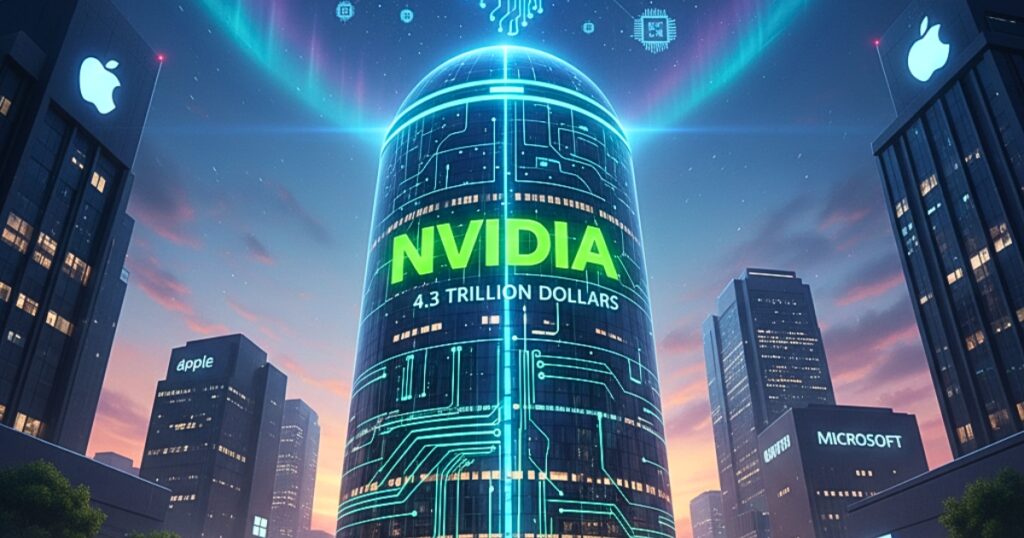
Jensen Huang’s company becomes the world’s most valuable, driven by its dominance in chips that power the artificial intelligence revolution.
When you think of the most valuable company on Earth, names like Apple or Microsoft usually come to mind. However, the rise of artificial intelligence (AI) has reshaped the financial markets and catapulted Nvidia — a company that started in 1993 building graphics cards for gamers — to the very top, redefining the future of computing.
In July, Nvidia became the first company ever to surpass $4 trillion in market capitalization. Today, with a value hovering around $4.3 trillion, it has dethroned the long-standing tech giants and cemented itself as the dominant player in the AI era.
From Graphics to Data Computing
Founded by Jensen Huang, Chris Malachowsky, and Curtis Priem, Nvidia was born with a mission to bring 3D graphics to gaming and multimedia markets. The turning point came in the mid-2000s, when Huang bet on transforming graphics cards into powerful supercomputers. That vision became reality in 2006 with CUDA, a programming interface that allowed GPUs to be used for far more than video games, laying the foundation for accelerated computing.
Nvidia’s GPUs, capable of performing thousands of calculations in parallel, became the perfect tool for training deep learning models. In 2012, its technology was used to train AlexNet — an image classification system — dramatically faster than conventional CPUs. That breakthrough convinced Huang to pivot the company toward the AI market.
The AI Gold Rush
Since the launch of ChatGPT in 2022, Nvidia’s GPUs have become the most sought-after resource in Silicon Valley and by governments racing for AI dominance. Between 2023 and 2025, Nvidia’s stock skyrocketed by more than 800%, marking the most dramatic market cap growth in recent memory. According to Forbes, Nvidia’s stock price has surged nearly 35,000% in the past decade.
Its H100 chip has become the flagship product for tech giants, while nations like Saudi Arabia and the UAE are purchasing thousands of units to fuel their AI agendas. The newly introduced H200 chips promise even greater computing power, reinforcing Nvidia’s role as the backbone of this technological revolution.
Challenges and Strategic Expansion
Nvidia’s meteoric rise hasn’t been without challenges. This September, China banned the sale of advanced AI chips in its territory, forcing Nvidia to recalibrate its market approach. Just one day later, Nvidia announced a $5 billion investment in Intel to collaborate on next-generation hyperscale data centers.
Analysts like Beth Kindig of I/O Fund predict Nvidia could hit a $6 trillion valuation by 2026. The Motley Fool notes that as AI workloads grow, demand for advanced infrastructure will only increase — and Nvidia’s GPUs remain the essential engine powering it all.
The Future of NVIDIA
The coming year will be decisive, as Nvidia plans to roll out its next-generation GPU architecture. If it maintains its lead, it could become the first company to reach a $6 trillion valuation, securing its role as the key driver of the AI-powered digital age.
Nvidia’s story is one of a company that reinvented itself at the right time, betting on a vision that transformed the tech world. Today, it not only leads the stock market but also powers the infrastructure shaping the future of humanity’s digital revolution.