
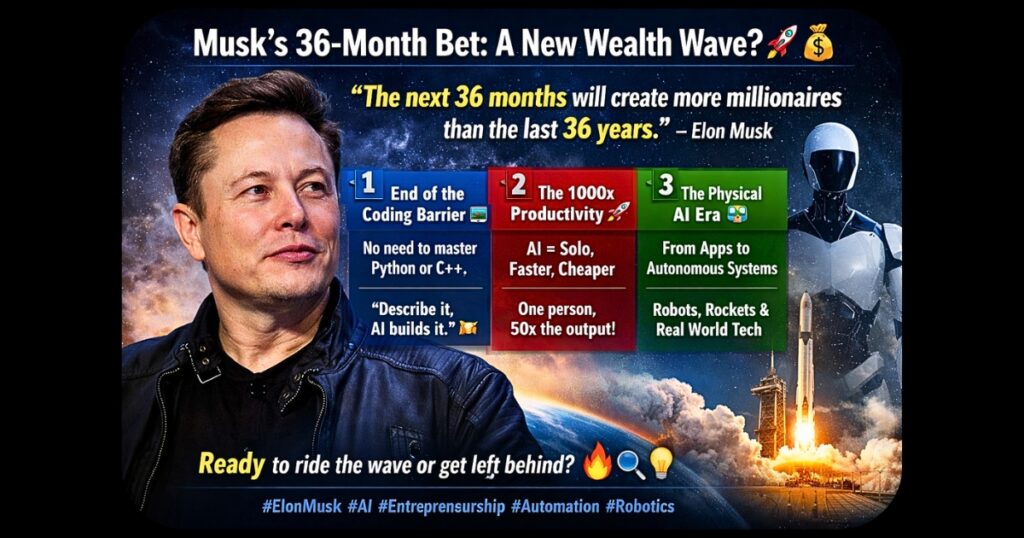
Elon Musk predicts the next three years will mint more millionaires than the past three decades, driven by AI, automation, and collapsing entry barriers.
A 36-Month Countdown to a New Economic Order
When Elon Musk warns that the next 36 months could create more millionaires than the previous 36 years, he is not offering motivational rhetoric. He is outlining a structural shift in how capital, labor, and intelligence intersect.
According to Musk’s thesis, the convergence of artificial intelligence, automation, and accessible computing power has dismantled traditional barriers to wealth creation. The implication is stark: opportunity now scales at machine speed. Those who adapt early stand to benefit disproportionately.
From Code to Conversation: The Collapse of the Developer Gate
For decades, technological entrepreneurship required mastery of programming languages such as Python or C++. The technical barrier filtered participation to a narrow segment of the population.
Musk’s concept—often described as “vibe coding”—suggests that natural language has become the new programming interface. Instead of writing complex syntax, entrepreneurs describe outcomes. AI systems translate intent into executable code.
The economic consequence is profound:
-
Technical specialization is no longer a prerequisite for innovation.
-
Product prototyping cycles shrink from months to hours.
-
Capital requirements for software development decline sharply.
In practical terms, this democratizes company formation. If you can articulate a problem clearly, AI can increasingly generate the solution architecture.
The 1000x Productivity Shock
Historically, scaling a company required large teams, heavy payrolls, and multi-layered management. Today, AI agents can replicate functions once handled by entire departments—marketing analytics, customer service automation, financial modeling, even product design iterations.
The “solopreneur” model is no longer theoretical. With AI orchestration tools, a single operator can coordinate workflows equivalent to a 50-person operation.
This produces two simultaneous effects:
-
Operating costs approach asymptotic lows.
-
Output per individual skyrockets.
Such productivity compression accelerates capital accumulation for agile founders while disrupting traditional labor structures.
The Shift from Digital Apps to Physical AI
The previous three decades were dominated by internet platforms and mobile applications. The next cycle, Musk argues, belongs to physical AI systems—machines that act autonomously in the real world.
Examples already in development include:
-
Tesla Optimus, the humanoid robotics platform designed for industrial and domestic labor.
-
Autonomous logistics networks.
-
Space-based infrastructure tied to Musk’s broader ecosystem through Tesla and SpaceX.
The capital migration is notable. Venture funding is increasingly flowing toward robotics, automation hardware, and AI-integrated manufacturing systems. The center of gravity shifts from “software interfaces” to “autonomous execution.”
Why the Early-Access Window Is Narrowing
Technological revolutions follow a predictable curve:
-
Early adopters capture asymmetrical returns.
-
Infrastructure matures.
-
Competition intensifies.
-
Margins compress.
Musk’s 36-month horizon implies we are still in the early acceleration phase. However, the democratization of AI tools also means adoption velocity is historically unprecedented. The window may close faster than prior industrial cycles.
In this context, curiosity, adaptability, and prompt engineering literacy may matter more than formal credentials.
The Bottom Line: A Repriced Barrier to Billion-Dollar Entry
Musk’s wager is straightforward: the cost of launching a billion-dollar enterprise has never been lower. Capital intensity is falling. AI reduces execution friction. Distribution is global from day one.
This does not guarantee universal wealth creation. It signals redistribution—toward those who leverage machine intelligence as a force multiplier.
If the prediction holds, the next 36 months may not merely create millionaires. They may redefine who qualifies as an entrepreneur in the first place.