
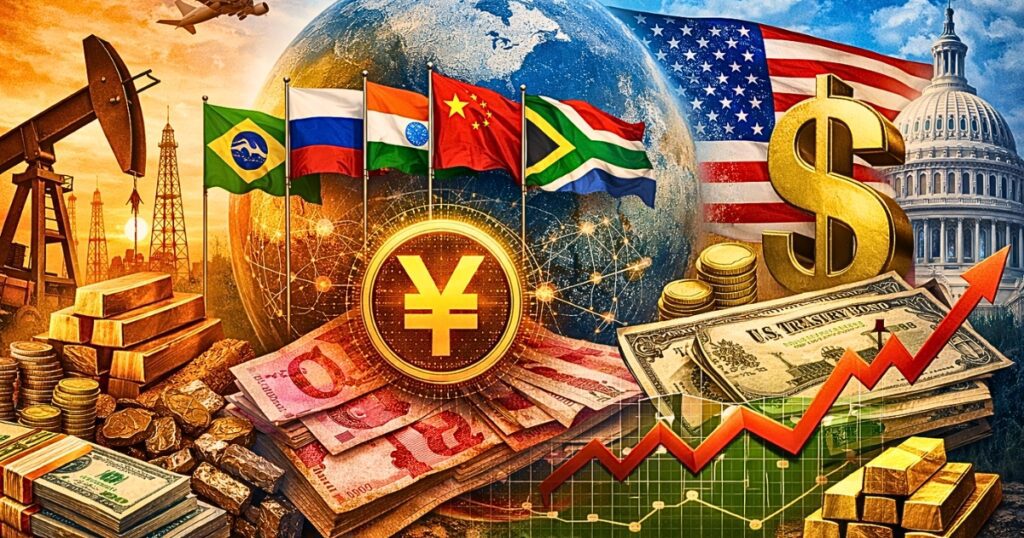
Commodities, currencies, U.S. Treasuries and the BRICS factor shape a shifting multipolar economy, outlining today’s conditions and future best- and worst-case scenarios.
A Global Economy in Transition
The global economy is no longer operating under a single dominant center of gravity. While the United States and developed markets remain influential, the rise of the BRICS bloc—Brazil, Russia, India, China, and South Africa, alongside new members—has accelerated the transition toward a multipolar economic system.
This structural shift is reshaping trade flows, capital markets, and monetary influence. Commodities, currencies, and U.S. Treasury bonds now reflect not only cyclical economic pressures, but also deeper geopolitical and systemic realignments.
Commodities: Strategic Assets in a Multipolar World
In a multipolar system, commodities are no longer just inputs for growth—they are instruments of strategic power.
-
Energy: Oil and gas markets are increasingly influenced by non-Western producers and alternative trading mechanisms, including bilateral agreements and non-dollar settlements among BRICS members.
-
Industrial Metals: China’s central role in demand for copper, lithium, and rare earths reinforces its leverage in global supply chains, especially for energy transition technologies.
-
Precious Metals: Gold has gained renewed relevance as several central banks—particularly within the BRICS—diversify reserves away from the U.S. dollar.
Commodities are signaling a world where supply security and geopolitical alignment matter as much as price and demand.
Currencies: De-Dollarization and Its Limits
Currency markets sit at the core of the multipolar debate. While the U.S. dollar remains dominant, its uncontested supremacy is increasingly questioned.
-
U.S. Dollar: The dollar continues to benefit from high interest rates, deep capital markets, and safe-haven status. However, its share in global reserves has gradually declined.
-
BRICS Currencies: China’s yuan has expanded its role in trade settlement, particularly in energy and commodity transactions. Discussions around a common BRICS settlement mechanism highlight long-term ambitions, even if implementation remains complex.
-
Emerging Markets: Multipolarity offers alternatives to dollar dependence, but also exposes weaker currencies to fragmentation and volatility.
The result is not the end of the dollar, but a more contested and diversified currency landscape.
U.S. Treasury Bonds: Still Central, Increasingly Challenged
U.S. Treasury bonds remain the backbone of the global financial system, yet they now operate in a more competitive environment.
-
Yields: Elevated yields reflect persistent inflation risks and heavy government borrowing.
-
Foreign Demand: While Treasuries remain essential, some BRICS nations have reduced marginal exposure, favoring gold or domestic investments.
-
Systemic Role: In times of crisis, Treasuries still function as the ultimate safe asset, underscoring the gap between ambition and reality in the multipolar shift.
Bond markets continue to price slower growth ahead, even as they reveal the limits of de-dollarization.
Where the Global Economy Stands Today
So far, the global economy has avoided a synchronized downturn. Growth is uneven, inflation is moderating but not defeated, and financial conditions remain tight. The multipolar transition adds complexity: policy decisions in Beijing, New Delhi, or Riyadh now carry weight comparable to those in Washington or Brussels.
Economic resilience exists, but it is increasingly fragmented across regions and alliances.
Best-Case Scenario: Orderly Multipolar Adjustment
In the most favorable outcome:
-
Inflation continues to decline globally.
-
Central banks coordinate indirectly through stability-focused policies.
-
Commodities stabilize within a strategic but functional market framework.
-
The dollar remains dominant but coexists with stronger regional currencies.
-
U.S. Treasury yields ease, supporting global investment.
This scenario reflects a controlled evolution toward multipolarity without systemic disruption.
Worst-Case Scenario: Fragmentation and Financial Stress
In the downside scenario:
-
Geopolitical tensions intensify between economic blocs.
-
Commodities are weaponized through supply restrictions.
-
Accelerated de-dollarization triggers currency instability.
-
Capital flows fragment, weakening global liquidity.
-
Bond markets signal deep recession amid rising sovereign risk.
Such an outcome would mark not just a cyclical downturn, but a disorderly transition in the global financial system.
Power, Policy, and Prudence
Commodities, currencies, and U.S. Treasury bonds now reflect more than economic cycles—they embody a shifting balance of global power. The rise of the BRICS and the move toward a multipolar system do not eliminate existing structures, but they redefine how influence is exercised.
The path ahead depends on whether this transition is managed through cooperation and gradual adjustment, or driven by confrontation and fragmentation. For markets and policymakers alike, understanding multipolar dynamics is no longer optional—it is essential.
By Orlando J. Gutierrez