
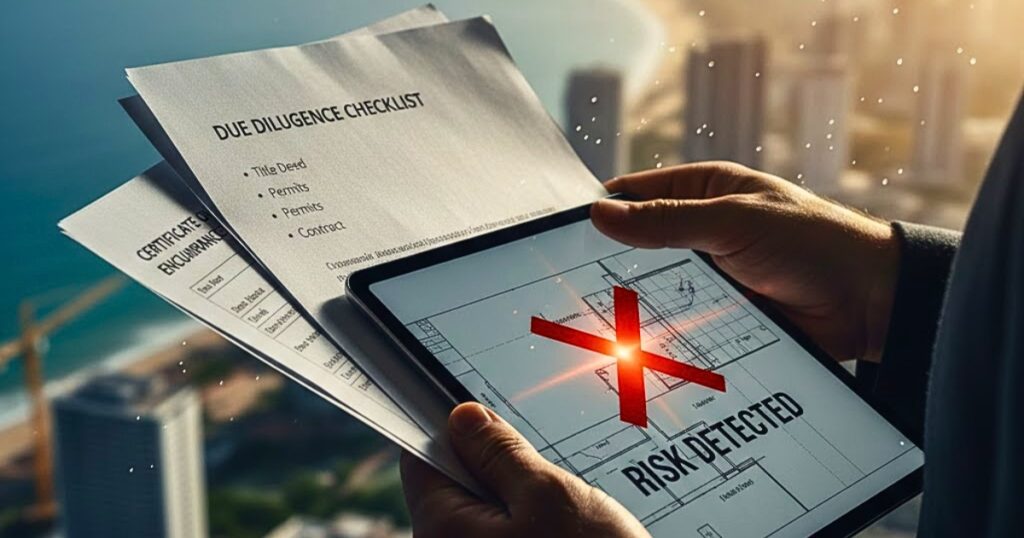
Real estate speculation attracts capital, but the lack of due diligence is a fatal risk. Learn the essential checklist to shield your assets against developers and sellers without legal backing.
📜 The First Million-Dollar Mistake: Universal Legal Blindness
In emerging markets and high-growth areas, the promise of accelerated capital appreciation and avant-garde designs often serve as the main lure for investors. However, the most costly and common mistake worldwide is the omission of document verification.
The pressure from “opportunity sales” or “below-market prices” often leads buyers to skip Due Diligence, resulting in the acquisition of assets without building permits, with hidden debts, or, worse, those that legally do not belong to the seller. This oversight transforms an investment into a costly legal dispute.
🔨 The Three Fundamental Pillars of Verification
To transform any real estate promise into a secure asset, the buyer must base their decision on these three ineluctable legal and structural axes:
I. Certainty of Ownership: Who Sells and What They Own
This step verifies that the seller has the legal capacity to sell and that the property is free of encumbrances.
| Key Document | Purpose of Examination | Risk Prevented |
| Title Deed (Escritura) | Proves that the seller is the legal owner registered with the corresponding public entity. | Avoids purchasing properties that belong to third parties or are subject to fraud. |
| Certificate of Encumbrances / Charges | Confirms with the Public Registry that the property is free of mortgages, liens, or active litigation that could compromise the transaction. | Protects against acquiring hidden debts associated with the property. |
| Tax Clearance Receipts | Verifies that all local taxes (property tax, services) are paid and up-to-date at the time of the sale. | Prevents the buyer from assuming the seller’s outstanding fiscal obligations. |
II. Project Viability: Permits and Land Use
A property can be legal, but if it is not authorized for the intended use or construction, it is worthless.
-
Land Use Permit: This is the municipal or state authorization that defines whether the location allows the promised residential, commercial, or tourist development. It is the core permit that legitimizes the project.
-
Urbanization and Building Permits: Authorize the execution of infrastructure works (streets, basic services, and structures). Their absence in a new development indicates the work is illegal and can be shut down at any time.
-
Environmental Assessment: In sensitive areas (coasts, reserves), verifying Environmental Impact approval is crucial to ensure the legal continuity of construction.
III. Contractual Shielding and Expert Advice
The final protection of capital lies in the agreed-upon terms and conditions.
-
Independent Legal Review: The biggest mistake is to accept the contract without it being reviewed by a lawyer separate from the seller. The professional must seek clauses that unfairly penalize the buyer or exempt the developer from essential responsibilities.
-
Clear Terms: The contract must detail the exact delivery dates for the property and the promised infrastructure.
-
Symmetrical Penalties: An equitable compensation mechanism must be established: if the buyer is fined for delayed payment, the seller must be penalized for delayed delivery of the work.
🤝 The Virtuous Circle of Professionals
A smart investor hires a team. This structure of advisory service is universal:
-
Legal Counsel/Real Estate Attorney: Expert in contracts and documents (Pillar I and III).
-
Certified Appraiser/Property Inspector: Expert in the physical and structural condition (Pillar II).
-
Financial/Mortgage Advisor: Expert in purchasing power and total costs (closing costs, taxes, and rates).
Real Estate Maxim: The cost of complete Due Diligence will always be infinitely less than the cost of litigation or the total loss of the investment due to legal or structural failures.
By Orlando J. Gutierrez