
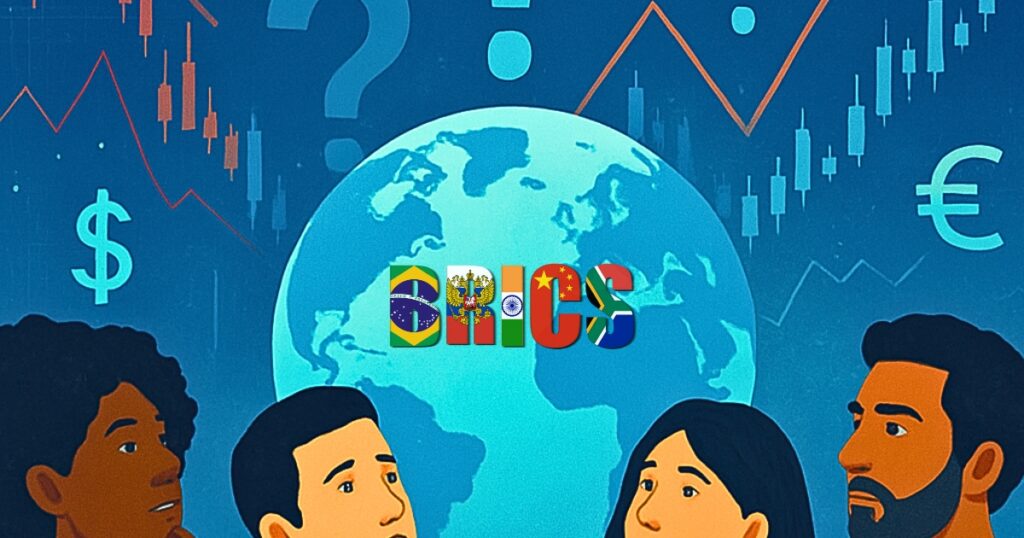
As geopolitical tensions reshape alliances, the BRICS+ expansion signals a shift toward a more multipolar and uncertain economic landscape.
2026: An Economy in Transition Toward a Multipolar Era
Forecasting the global economy heading into 2026 is no longer a matter of analyzing predictable cycles. Instead, it requires understanding a profound systemic shift. The world is moving away from decades of U.S.-centric economic dominance and toward a multipolar architecture, where the growing influence of BRICS+ is reshaping financial power structures and political alignments.
This transition unfolds alongside technological upheaval, climate instability, and rising geopolitical fragmentation—making the future less predictable than at any time in recent history.
From Unipolar Dominance to Multipolar Competition
After the Cold War, most global financial institutions and trade systems operated under U.S. leadership and the dollar standard. But after 2008 and especially post-pandemic, cracks emerged.
Now, powerful emerging economies including China, Russia, India, Brazil, Saudi Arabia, South Africa, Iran, Egypt and others are asserting themselves through the BRICS+ platform.
Collectively, BRICS+ represents:
-
Over 45% of the world’s population
-
Nearly 35% of global GDP (PPP)
-
A commanding share of energy, agriculture, and critical minerals
These numbers are not symbolic—they are strategic leverage.
BRICS+: The Rise of an Alternative Economic System
The appeal of the BRICS+ bloc is grounded in three key pillars:
1. A Parallel Financial System
BRICS nations are accelerating strategies to reduce dependence on the U.S. dollar by:
-
Settling trade in national currencies
-
Strengthening payment systems such as CIPS or MIR
-
Exploring a digital reserve currency backed by commodities
This movement is known globally as de-dollarization.
2. Infrastructure and Energy Investment
Through the New Development Bank (NDB), member nations finance large-scale infrastructure, renewable energy, logistics and digital corridors, often with fewer political conditions than Western institutions.
A new financial geography is emerging.
3. Engines of Growth
While Western nations battle aging populations, polarization and historic debt levels, BRICS+ countries maintain:
-
Younger labor forces
-
Fast industrial expansion
-
Strong resource portfolios
For investors, these are not speculative markets — they are growth frontiers.
A World Split Between Cooperation and Fragmentation
Despite the momentum of BRICS+, uncertainty remains. Three major forces will define outcomes heading into 2026:
1. Escalating Geopolitical Competition
The world may align into three potential blocs:
-
Western financial order
-
BRICS+ energy and commodity economies
-
Non-aligned actors balancing both sides
Supply chains, technology access, and energy markets hinge on this alignment.
2. Technology as a Geopolitical Weapon
Innovation has become a new arms race.
Both blocs compete to dominate:
-
AI
-
Quantum computing
-
Chips and semiconductors
-
Digital currency and data sovereignty
The winner will shape economic rules—not just markets.
3. Climate Instability and Resource Scarcity
Extreme weather now affects economic planning, risk modeling, insurance systems and infrastructure.
BRICS+ nations are responding through diversified energy strategies: fossil fuels, renewables, nuclear, and rare mineral control—a pragmatic approach to transition.
How to Prepare for a Future That Cannot Be Predicted
Since precision forecasting is impossible, adaptability replaces prediction.
Businesses should:
-
Diversify supply chains between West and BRICS+ hubs
-
Increase liquidity and lower variable-rate debt
-
Invest in technology and workforce adaptability
Investors should:
-
Include emerging markets, commodities, energy and infrastructure
-
Prioritize real-value assets over speculative trends
-
Maintain liquidity reserves
Governments should:
-
Strengthen energy and food security
-
Invest in education and digital sovereignty
-
Modernize infrastructure and regulatory agility
Conclusion: A Challenging Future, but Full of Opportunity
The world heading into 2026 will not be linear. It will be shaped by disruption, competition and innovation. The expansion of BRICS+ does not guarantee stability—but it offers an alternative framework: more plural, more distributed, and potentially more balanced.
The global economic order is being rewritten.
And for the first time in decades, the center of gravity may no longer be singular — but shared.
By Orlando J. Gutierrez